
Table of Contents
- Why Quality Home Goods Cost More: The Real Economics
- How to Spot High Quality Furniture in Person and Online
- Material Quality and Construction Standards: What Separates Good From Cheap
- How to Avoid Online Shopping Scams When Buying Home Goods
- Fast Decor vs Sustainable Home Goods: The Long-Term Cost Difference
- The Hidden Costs of Supply Chain Logistics and Import Duties
- Cost-Per-Use: Why Paying More Often Costs Less
- Frequently Asked Questions
Last Updated: September 16, 2026
Why Quality Home Goods Cost More: The Real Economics
A solid oak dining table and a particleboard lookalike can sit side by side in a showroom, finish for finish, and still carry wildly different price tags. That gap reflects real differences in materials, construction, labor, and the supply chain that moves both pieces from factory to your living room.
How to Spot High Quality Furniture in Person and Online
Spotting high quality furniture comes down to three checks: what it is made of, how it is joined, and how honestly the seller describes it. In person, run your hand along edges and undersides. Online, read the material specifications line by line instead of trusting the hero photo.
A practical inspection routine:
- Check whether the frame is solid wood, plywood, or particleboard
- Look at the joinery: mortise-and-tenon and dovetail joints outlast staples and glue
- Press on the surface to feel for veneer lifting or hollow spots
- Ask what the weight capacity is and whether it is tested
- Confirm the finish is sealed, not just stained
Material Quality and Construction Standards: What Separates Good From Cheap
Material quality and construction standards separate good furniture from cheap furniture more than any brand name ever will. But "quality" is not a vibe, it is a set of measurable properties. Once you know the numbers, you can compare a $200 chair and a $900 chair on the same terms.
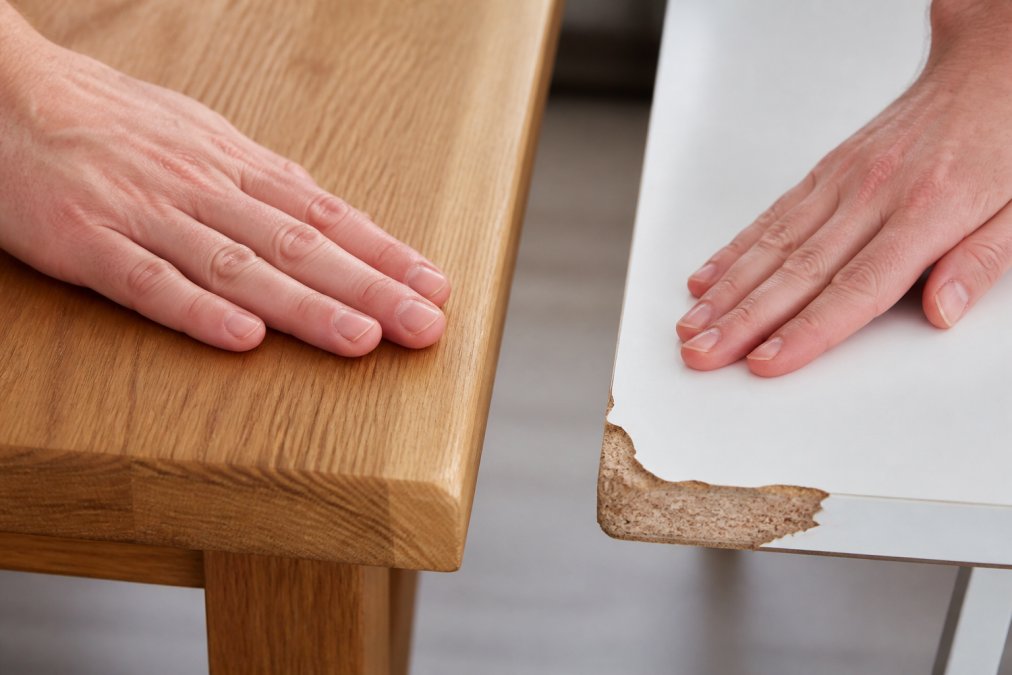
Solid wood vs. veneer vs. particleboard
These three are not interchangeable, and the difference is structural, not cosmetic.
- Solid wood is milled from a single piece of lumber. It can be sanded, refinished, and repaired repeatedly. It also moves with humidity, which is why quality makers kiln-dry lumber to a target moisture content, commonly 6-8% for furniture-grade stock, so it does not warp in your home.
- Plywood is thin layers of wood veneer glued in alternating grain directions. That cross-grain construction makes it dimensionally stable and strong for its weight. High-quality plywood (often called furniture-grade or Baltic birch) has many thin plies and no voids; cheap plywood has few thick plies and hidden gaps that telegraph through the surface.
- Particleboard and MDF are sawdust or wood fiber bonded with resin. They are flat, uniform, and inexpensive, and they hold a screw poorly once it has been removed. MDF is denser and machines more cleanly than particleboard, but neither tolerates moisture or repeated disassembly.
Joinery: the load-bearing detail
Joinery is where construction quality becomes visible in the price. A mortise-and-tenon joint, a dovetail, or a doweled and glued corner block distributes stress across a large surface area. Staples and screws driven straight into particleboard concentrate stress at a few points and loosen with use.
Upholstery and textiles: the numbers behind the feel
Fabric and foam are where the biggest hidden quality gaps live, because they are the hardest to inspect online.
- Foam density is measured in pounds per cubic foot (PCF). Common furniture foam runs roughly 1.5-2.5 PCF; higher-density foam (often 2.5 PCF and up) resists sagging and holds its shape longer. A cushion that flattens in a year is usually a low-density foam problem, not a fabric problem.
- Fabric abrasion resistance is measured by the Martindale or Wyzenbeek rub test. Residential upholstery commonly targets around 15,000 double rubs for light use, with higher counts (often 30,000+) for heavy-use family furniture. A higher rub count is not a guarantee of comfort, but it is a reasonable proxy for how long the surface will survive daily wear.
- Thread count matters for bedding, but only up to a point. Very high counts are often achieved with thinner, weaker yarns or multi-ply construction that inflates the number without improving hand-feel. A well-made 300-count long-staple cotton sheet can outperform a poorly made 1,000-count sheet.
Quality control testing
None of this means cheap materials are always the wrong choice. It means the price difference is usually traceable to specific, nameable properties, species, ply count, joint type, foam density, rub count, and testing, not branding alone.
How to Avoid Online Shopping Scams When Buying Home Goods
Avoiding online shopping scams starts with slowing down. Most scams rely on urgency, a price that is too good to be true, and a seller who cannot be verified. If all three appear together, treat it as a warning sign.
Watch for these patterns:
- Prices far below every other listing for the same item
- No physical address or verifiable business details
- Reviews that are all five stars and all posted in the same week
- Payment methods that offer no buyer protection
- Product photos that appear on multiple unrelated sites
Fast Decor vs Sustainable Home Goods: The Long-Term Cost Difference
Fast decor versus sustainable home goods is really a question of how many times you want to buy the same thing. Fast decor is built to be replaced. Sustainable home goods are built to be kept, and the math favors keeping once you count replacements.
| Factor | Fast Decor | Sustainable Home Goods |
|---|---|---|
| Typical lifespan | 1-2 years | 10+ years |
| Replacement frequency | Frequent | Rare |
| Materials | Particleboard, thin veneer | Solid wood, quality plywood |
| End of life | Often landfill | Repairable, refinishable |
| Cost per year | Higher over time | Lower over time |
The Hidden Costs of Supply Chain Logistics and Import Duties
Supply chain logistics and import duties are invisible on the showroom floor but very visible on the invoice. Every imported home good carries a landed cost, the total expense to get one unit from the factory door to your door, and that number, not the factory price, is what the retailer marks up.
What "landed cost" actually includes
Landed cost is a stack of line items, each of which scales differently:
- Ex-works price, what the factory charges for the goods themselves.
- Freight, ocean, air, or truck. Ocean freight is priced per container, so bulky items are penalized by volume, not weight.
- Insurance, a small but real percentage of cargo value.
- Duties and tariffs, a percentage of the declared value, set by trade policy, not by quality.
- Customs brokerage and clearance, flat fees per shipment plus paperwork.
- Port fees, drayage, and warehousing, moving goods from port to a distribution center and storing them until they sell.
- Last-mile delivery, the most expensive leg per unit for large furniture.
How duties and tariffs are calculated
Import duties are typically assessed as a percentage of the declared customs value of the goods, and the rate depends on the product's classification under the Harmonized System (HS) code and the country of origin. That is why the same chair can cost more depending on where it was made and which trade agreement applies. Tariff rates change with policy, not craftsmanship, worth remembering when a price rises overnight without any change to the product.
Why two identical-looking chairs can differ in price
- One may have traveled a shorter, lower-tariff route.
- One may pack more efficiently, cutting freight per unit.
- One may be bought in volume, letting the retailer negotiate a better ex-works price and spread fixed logistics costs across more units.
- One may sit in a warehouse for six months, tying up capital recovered in the price.
For a buyer, the practical takeaway is to separate the two questions. Ask "what is this made of and how is it built?" to judge quality. Ask "where did it come from and how did it get here?" to understand the price. Retailers transparent about both, origin, materials, and the reason for the price, are usually worth buying from.
Cost-Per-Use: Why Paying More Often Costs Less
This is also where a curated retailer earns its place. When someone has already filtered out the items that fall apart, you spend less time researching and more time living with things that hold up. Munk'Goods builds its catalog around that idea, with a wide product selection and a dedicated range of car accessories for people who want their home and car to feel considered rather than cluttered.
Frequently Asked Questions
What are the primary factors that drive up the price of high-quality home goods?
Material quality, construction standards, and supply chain logistics are the biggest cost drivers. Solid wood, kiln-dried hardwoods, and high-density foam cost more than particleboard and low-density fillers. Quality assurance and manufacturing labor standards also add cost. Import duties and tariffs on raw materials push prices higher again. Each step that improves durability and appearance adds to the final price you pay.
How can you tell the difference between high-quality craftsmanship and mass-produced items?
Check joinery first. Dovetail joints, mortise-and-tenon construction, and corner blocking signal real craftsmanship. Staples and cam locks point to mass production. Look at weight: quality case goods feel heavier because they use denser materials. Run your hand along edges for smoothness. Ask about the manufacturer's quality control testing. A brand that publishes material specs and construction details is usually the one worth buying from.
Does paying more for home goods actually guarantee better longevity?
Not automatically, but the correlation is strong when you know what to look for. A higher price only delivers longevity if it reflects better material quality, construction standards, and quality assurance. A costly item made from particleboard will still fail early. Compare cost-per-use instead of sticker price. A well-built sofa that lasts 15 years often costs less per year than a cheap one replaced every three years.
How do ethical manufacturing practices impact the cost of home goods?
Factories that pay fair wages, follow safety rules, and run proper quality control testing charge more to produce each item. Those costs pass through to the retail price. Brands that cut corners on labor standards can sell cheaper, but the savings come from somewhere. When you buy from a brand that documents its manufacturing standards, part of what you pay goes toward safer, more accountable production.
Quality home goods cost more because durable materials, skilled construction, honest logistics, and real quality control all cost money, and cutting any of them shows up later as a replacement. Munk'Goods curates its selection so you can shop a vetted catalog instead of gambling on listings, with a wide product range and specialized car accessories under one roof. Continue shopping with Munk'Goods and find pieces built to stay in your home, not cycle through it.