
Table of Contents
- What Is a Curated Home and Why It Matters
- Curated vs Mass-Produced Home Decor: Key Differences
- Quality Home Decor: Materials, Craftsmanship, and Sourcing
- How to Curate Your Home: A Practical Method
- The Real Cost of Curated Home Goods vs Generic Decor
- Reducing Waste and Building a Timeless Interior
- Frequently Asked Questions
Last Updated: October 10, 2026
What Is a Curated Home and Why It Matters
A curated home is a living space where every item has been deliberately chosen to reflect your personal style, values, and needs. A curated home is a living space where every item has been deliberately chosen to reflect your personal style, values, and needs. Curated home goods form the foundation of a home that actually feels like yours.
Walk into a curated home and you notice intentionality. The decor tells a story. Nothing feels generic or out of place. The environment around you affects your mood, sense of belonging, and how you feel when you wake up or return home.
Curated home goods are typically made with better materials and last longer. When you choose deliberately, you reduce waste and build a collection that grows more meaningful over time.
Curated vs Mass-Produced Home Decor: Key Differences
The gap between curated and mass-produced home decor runs deeper than price. It's about how items are made, why they're made, and what happens to them after you buy them.
Intentional Selection vs Impulse Buying
Mass-produced decor thrives on impulse. You buy it, your taste shifts or it falls apart, and you replace it. This cycle repeats.
Curated selection requires asking: Will this still appeal to me in two years? Does it match my overall aesthetic? These questions force you to think about what you actually want rather than what's convenient.
People who curate their homes buy less frequently but spend more per item.
Durability and Replacement Frequency
Mass-produced items are engineered for cost, not longevity. Materials are cheaper, construction simplified, and finishes chip or fade within months.
Curated pieces are built to last. A handmade ceramic vase with quality glazing won't degrade like a thin mass-produced alternative. Solid wood won't warp like particleboard. These differences compound over years.

| Item Type | Mass-Produced Lifespan | Curated Lifespan | Cost Per Year (Mass) | Cost Per Year (Curated) |
|---|---|---|---|---|
| Ceramic vase | 6-12 months | 5+ years | $40-80 | $12-20 |
| Wall hanging | 1-2 years | 7+ years | $20-30 | $10-15 |
| Throw blanket | 1-2 years | 5+ years | $25-40 | $15-25 |
| Decorative shelf | 2-3 years | 10+ years | $30-50 | $10-20 |
Quality Home Decor: Materials, Craftsmanship, and Sourcing
Quality determines whether a piece survives, whether you'll still like it in two years, and whether it was made with care. When you evaluate curated home goods, you need a framework.
Materials: What to Look For and What to Avoid
Materials are the foundation of durability. Here's what to check:
Ceramics and pottery: Look for weight and thickness. The glaze should be smooth and even, without drips or thin spots. Avoid uneven pooling or rough bases. Ask the maker about clay body and whether it's food-safe. High-fire stoneware lasts longer than low-fire earthenware.
Wood and natural materials: Real wood shows natural variation; identical pieces suggest veneer over particleboard. Edges should be smooth and sealed. Hardwoods (oak, walnut, maple) outlast softwoods (pine). Natural finishes develop patina; synthetic ones can yellow or peel.
Textiles (blankets, macramé, wall hangings): Natural fibers (cotton, linen, wool, jute) age gracefully; synthetic blends pill and fade faster. Check weave density, tight weaves hold better. For macramé, knots should be even and tight.
Metal accents and frames: Look for solid construction, not hollow pieces. Brass and copper develop patina; stainless steel stays uniform. Avoid visible seams, rough welds, or sharp edges. Ask if the finish is sealed or will naturally oxidize.
Craftsmanship: Red Flags and Proof Points
Proof of human hands: Slight color variations, visible brush marks, natural imperfections (asymmetrical handles, minor tension changes), and a maker's mark or signature.
Red flags: Perfect uniformity, visible seams or staples, thin walls, rough edges, and no maker information.
Ask direct questions: How long does one piece take? What's your process? Can you show me your studio? Makers proud of their work answer these questions.
Sourcing Transparency: Tracing the Story
What to look for: A description explaining why they make things, material sourcing information, pricing that reflects the work, willingness to share process photos, clear care instructions, and a return policy.
Avoid: Unlabeled "artisan" claims, hidden sourcing, suspiciously low prices, and makers who won't answer questions.
Building Your Evaluation Checklist
Before you buy, check: Materials (substantial, appropriate, age well?), Craftsmanship (evidence of care and human hands?), Sourcing (who made it and why?), Longevity (will you want it in 5 years?). If a piece passes all four, it's worth keeping.
How to Curate Your Home: A Practical Method
Curation isn't about having a designer's eye or unlimited budget. It's a process anyone can follow, whether you own your space, rent it, have a small apartment, or need pieces to serve multiple functions.
Step 1: Define Your Personal Identity and Design Direction
Before you buy anything, define what your home should feel like. Not what's trendy. Not what your friends have. What resonates with you?
Ask yourself: What colors calm you? Do you prefer minimalist or layered spaces? What style feels like home? What emotions should your space evoke? Write this down, it becomes your filter to prevent pieces that don't fit together.
Step 2: Assess Your Space and Constraints
Curation must work within your reality. If you ignore practical constraints, you'll end up with beautiful pieces that don't fit your life.
For renters: Avoid permanent installations. Check lease restrictions. Prioritize portable pieces you can take when you move. Use removable hardware for wall decor.
Handmade Ceramic Vase, Vintag / →
For small spaces: Measure before shopping. Choose vertical storage and multifunctional pieces (storage ottoman, dividing bookshelf, light-reflecting mirror). Stick to 2-3 main colors plus neutrals.
For households with kids or pets: Choose durable materials (solid wood, washable textiles). Avoid fragile pieces in high-traffic areas. Prioritize easy-to-clean items and storage that hides clutter.
For multifunctional spaces: Choose neutral, versatile pieces that work across uses. Use storage to hide bedding and supplies.
Step 3: Choose Handcrafted and Distinctive Pieces (Strategically)
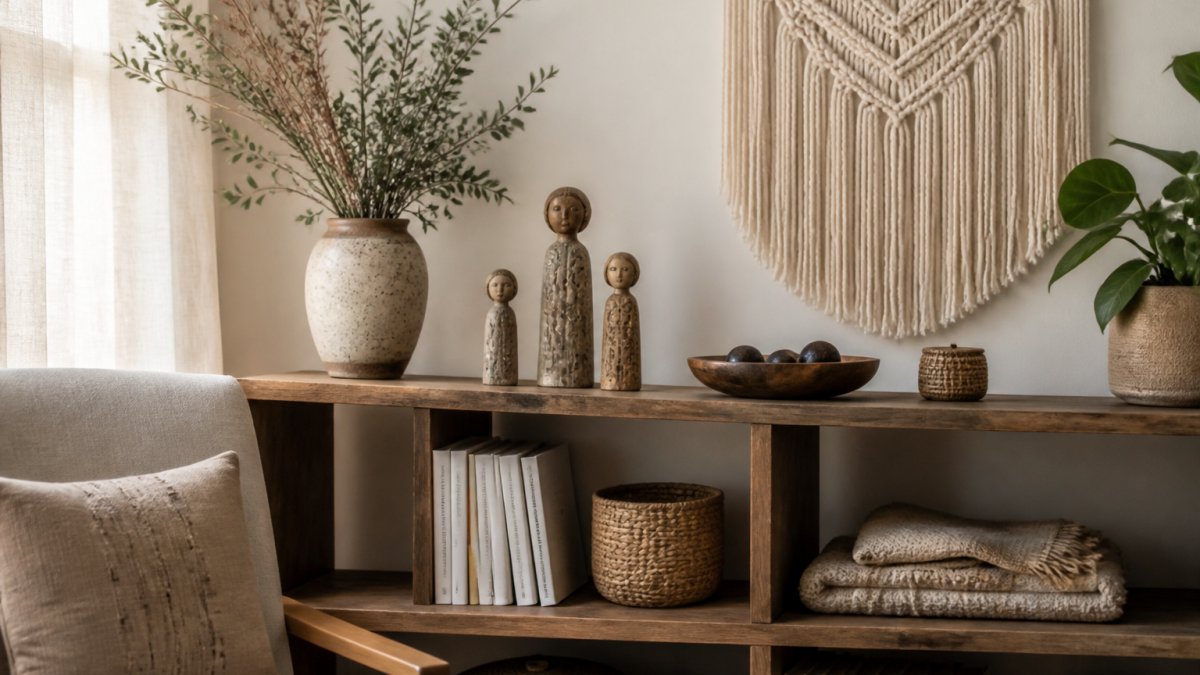
Look for items showing evidence of human hands: ceramic vases with color variations, macramé with visible knots, wooden pieces with natural grain. These imperfections prove authenticity.
The 70/30 rule: Build with 70% versatile, well-made basics and 30% distinctive statement pieces. Distinctive pieces (handcrafted vases, vintage textiles, sculptural stands) anchor a room. Versatile basics (minimalist vases, neutral blankets, simple shelves) form the foundation and work with multiple styles.
Step 4: Balance Unique Finds with Practicality and Longevity
The mistake many people make is choosing items purely for their uniqueness or beauty. A piece can be handcrafted and stunning but still impractical, too fragile, too niche, or too hard to integrate into daily life.
Before you buy, ask:
- Will I use this? Decorative items are fine, but they should still fit your life. A beautiful but fragile ceramic piece isn't curated if you're afraid to display it.
- Will it age well? Will it look dated in 3 years? Avoid hyper-trendy colors or styles. Stick to neutral bases with personality added through texture and handcrafted details.
- Can I maintain it? Does it require special care, cleaning, or storage? If yes, are you willing to do that?
- Does it fit my space? Not just physically, but aesthetically and functionally. A piece that's beautiful in a magazine might overwhelm your actual room.
- Can I afford to keep it? Not just the purchase price, but the cost of care, storage, and potential replacement if it breaks.
Step 5: Source Thoughtfully and Build Over Time
Curation is not a one-time project. It's an ongoing process of refinement.
Start small: Choose 3-5 pieces that match your personal style and fit your space. Arrange them thoughtfully. Live with them for a few weeks. Notice what works and what doesn't.
Add intentionally: When you want a new piece, go through the evaluation checklist (materials, craftsmanship, sourcing, longevity). Don't buy on impulse. Wait a week. If you still want it, buy it.
Rotate and edit: As your collection grows, you may find that some pieces no longer fit. That's okay. Remove them. Donate them. Rearrange what remains. Curation is about quality, not quantity.
Document your process: Take photos of your space as it evolves. Notice which pieces bring you joy, which feel out of place, which age beautifully. This feedback loop makes you a better curator over time.
Curation works for renters, small-space dwellers, and anyone with practical constraints, because it's not about perfection or expense. It's about intention, fit, and building a home that genuinely reflects who you are.
The Real Cost of Curated Home Goods vs Generic Decor
Price is where many people hesitate. A handcrafted ceramic vase costs more upfront than a mass-produced one. But the total cost calculation changes when you factor in longevity.
There's also a hidden cost to mass-produced decor: decision fatigue. When everything is cheap and replaceable, you buy more often. Every shopping trip becomes a decision point. Curated homes reduce this friction. You buy less often, choose more carefully, and spend less mental energy maintaining your space.
Reducing Waste and Building a Timeless Interior
Curated home goods align with reducing waste in a way mass production never can.
Fast decor creates waste. You buy something, use it for a season, and throw it out. The item ends up in a landfill. You buy a replacement, and the cycle repeats. Over years, this adds up to hundreds of items discarded.
Curated pieces are designed to last. You keep them. They develop patina and character. If you eventually replace them, they don't feel disposable, they've earned their place in your home.
Building a timeless interior means choosing pieces that won't feel dated in three years. Avoid hyper-trendy colors or styles. Stick to neutral bases with personality added through texture and handcrafted details. A Minimalist Porcelain Decorative Vase will look good in 2026 and 2031. A trendy neon decor piece probably won't.

This approach to curation naturally reduces waste. You're not replacing things constantly. You're building a collection that grows more meaningful over time, not one that empties your wallet or your conscience.
Curated home goods ask more of you upfront, more thought, more intention, sometimes more money per piece. But they deliver something mass-produced decor never can: a home that feels genuinely yours. At Munk'Goods, we've built our selection around this principle. We offer handcrafted pieces like our Handmade Ceramic Vase, Nordic Ceramic Figurines, and Bohemian Macrame that work together to create cohesive, lasting interiors. Start with one or two pieces that match your personal style, and build from there. Your home will thank you.

Frequently Asked Questions
What does it mean to have a curated home?
A curated home contains pieces intentionally selected to reflect your personal style and values rather than randomly assembled items. Each element, from furniture to decor, has purpose and meaning. This differs from mass-produced interiors where items are chosen primarily for convenience or trend. Curated homes prioritize quality, cohesion, and personal significance, creating spaces that feel authentic and lived-in rather than generic or staged.
How do curated home goods compare to mass-produced decor in terms of durability?
Curated home goods, especially handcrafted pieces, typically use quality materials and superior craftsmanship, lasting years or decades. Mass-produced items often prioritize cost reduction, resulting in cheaper materials, simpler construction, and shorter lifespans. A handmade ceramic vase or Nordic figurine maintains its beauty through regular use, while generic decor may fade, break, or feel outdated within months. Over time, curated pieces offer better value through lower replacement frequency and reduced waste.
Do curated home goods have to be expensive?
Curated doesn't mean costly. It means intentional. You can build a thoughtfully curated home at various price points by prioritizing quality over quantity and choosing pieces with personal meaning. Items like the Minimalist Porcelain Decorative Vase (£27.16) or Nordic Ceramic Figurines (£58.36) offer handcrafted quality without premium pricing. The key is buying fewer, better items that align with your aesthetic and last longer, reducing overall spending compared to frequently replacing cheap decor.
How can I make my home decor feel more cohesive when curating?
Build cohesion by choosing a consistent design aesthetic, whether minimalist, bohemian, rustic, or modern, and selecting pieces that share materials, colors, or styling. Arrange items with intention: group similar heights and textures, use negative space to avoid clutter, and layer pieces thoughtfully. Handcrafted elements like macrame, ceramic vases, and figurines naturally complement each other when they share a design language. This intentional approach creates a room that feels designed rather than assembled.