
Table of Contents
- Why Minimalist Desk Accessories Change How You Work
- Quick Comparison: Minimalist Desk Accessories Compared
- Minimalist Desk Organization Ideas for Small Spaces
- Desk Cable Management Solutions That Actually Stay Tidy
- Best Desk Accessories for Productivity (and What to Skip)
- DIY vs. Premium: What's Worth Paying For
- Cleaning and Maintenance for a Clutter-Free Desk
- Frequently Asked Questions
Last Updated: September 12, 2026
Why Minimalist Desk Accessories Change How You Work
A cluttered desk quietly taxes your attention all day. Every stray cable, stacked paper, and orphaned pen competes for focus you could spend on actual work. Minimalist desk accessories for home office setups solve this by giving every object a defined home, so your surface stays clear and your mind stays on task.
This guide from Munk'Goods breaks down what actually earns a place on your desk in 2026, what to skip, and how to organize a small space without spending much. The psychology here is simple: visual noise creates cognitive load. Remove the noise, and the work gets easier.
Quick Comparison: Minimalist Desk Accessories Compared
Here is how the core categories stack up, so you can decide where to spend first.
| Accessory Type | Typical Price | Solves | Best For |
|---|---|---|---|
| Desk edge hook | $3.65 | Bag and cable clutter | Small desks, commuters |
| Hanging storage basket | $6.00 | Loose small items | Cabinet and shelf edges |
| Lid and divider organizer | $6.52 | Flat item stacking | Drawers, trays, shelves |
| Drainage rack with board | $9.79 | Wet item storage | Multi-use surfaces |
| Decorative figurine | $21.61 | Visual focal point | Shelves, consoles |
| Porcelain vase | $27.16 | Empty surface styling | Desks, nightstands |
The pattern is clear: the functional pieces cost the least and do the most work. Decorative pieces come last, once the surface is already under control.

Minimalist Desk Organization Ideas for Small Spaces
Small-space desks fail for one reason: everything lands on the surface because there is nowhere else to put it. The fix is vertical and edge-based storage that uses space you already have but are not using.
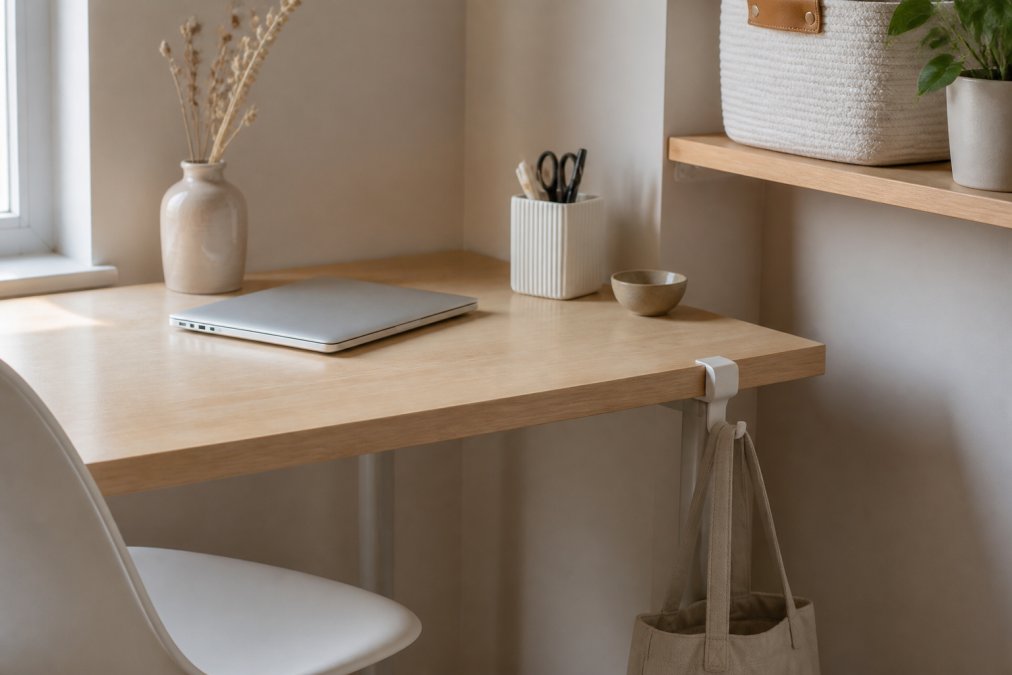
Two moves handle most of it.
Hanging Storage That Uses Door and Desk Edges
The Adjustable Desk Edge Hook is the single highest-return item on a small desk. It clamps over the desk edge without drilling, holds a bag, headphones, or a cable bundle, and folds flat when you travel. At $3.65, it clears more surface than most organizers costing ten times as much.
For cabinet or shelf edges, the Hanging Storage Basket hangs over a door or shelf lip with no screws. The perforated design keeps contents visible and lets air circulate. Use it for chargers, adapters, and the small items that otherwise migrate across your desk.

Trays and Dividers That Keep Surfaces Clear
Flat items are the hardest to keep tidy because they stack and slide. The Lid and Divider Organizer uses six dividers to hold notebooks, folders, or tablet sleeves upright instead of in a pile. It is built from BPA-free PP, so it wipes clean easily.

Desk Cable Management Solutions That Actually Stay Tidy
Cable mess returns because most systems only hide cables, they do not route them. A cable routed along a fixed path with a defined anchor point stays put. A cable bundled loosely will drift back within a week.
The desk edge hook doubles as a cable anchor. Run your charging cable through it at a fixed point, and it stops sliding off the desk every time you unplug. For a multi-device setup, route each cable separately rather than bundling everything into one mass. When one cable fails, you replace one, not the whole bundle.
A simple three-step routine keeps it working:
- Anchor each cable at the desk edge
- Label both ends with a small tag
- Re-check routing once a month
According to the U.S. Consumer Product Safety Commission, tangled and damaged cords are a recurring cause of household electrical incidents, which is one more reason to route cables deliberately rather than let them pool behind the desk.
Best Desk Accessories for Productivity (and What to Skip)
The best desk accessories for productivity are the ones you touch every day. Everything else is decoration with a job title. Before buying anything, run it through one question: does this get used daily, or does it just look tidy in a photo?
Most practitioners find that a minimalist setup works best when it is built around three functional zones: a capture zone for incoming items, a working zone for active tools, and a storage zone for everything else. If an accessory does not serve one of those zones, it is probably clutter in waiting.
Worth buying:
- An edge hook for bags and cables
- A divider organizer for flat items
- One small tray for pens and keys
- A single decorative piece, if the surface is already clear
Skip:
- Multi-tier plastic organizers that collect dust
- Cable boxes that trap heat and hide problems
- Matching sets bought before you know what you actually store
The Ergonomic Layer Most Minimalist Guides Skip
Minimalism and ergonomics are not opposites. A clean desk that forces you into a hunched posture is not a productive desk. The accessories that earn their place here are the ones that adjust your relationship to the screen, not just the surface.
A laptop stand is the highest-impact ergonomic accessory for a home office. Raising the screen to roughly eye level reduces neck flexion, and the keyboard moves to a separate tray or lower surface. If you use an external monitor, a simple riser or a stack of books under the stand achieves the same alignment. The goal is the top third of the screen at or slightly below eye level when you sit upright.
A footrest is the second most underrated piece. Most home office chairs are not adjustable enough to keep thighs parallel to the floor, and a footrest restores that angle without replacing the chair. A rolled towel or a low box works as a budget version before you buy anything.
A wrist rest is worth considering only if your keyboard sits flat and your wrists drop below the key plane. A folded cloth or a gel pad both work; the mechanism is the same, keeping the wrist neutral rather than extended.
What to skip in this layer: monitor arms that clamp to a desk too thick for the clamp, keyboard trays that reduce knee clearance, and any ergonomic accessory bought before you have measured your seated eye height and elbow height. Measure first, then buy.
Decor That Earns Its Place on the Desk
One well-chosen piece beats five average ones. The Minimalist Porcelain Vase at $27.16 has clean lines and works with dried stems or on its own as a sculptural accent. The Nordic Home Decor Figurines at $21.61 are compact enough for a shelf edge without crowding your working area.
The rule for desk decor: if it blocks your sightline to the monitor or your reach to the keyboard, it does not belong on the desk. A common pattern is to place one vertical element (vase, small plant, figurine) at the outer edge of the working zone, where it frames the space without entering it.
DIY vs. Premium: What's Worth Paying For
Spending more only pays off on items you handle daily. A $3.65 desk edge hook and a $30 designer version do the same job. The difference is finish and material, not function.
Where premium earns its price:
- Materials that resist wear, like aluminum alloy over thin plastic
- Pieces that stay in view, where finish actually shows
- Items you will keep for years, not replace each season
Where DIY wins:
- Drawer dividers cut from cardboard or foam board
- Cable anchors made from adhesive clips
- Trays repurposed from shallow boxes
The honest trade-off: budget pieces save money but may need replacing sooner, while premium pieces cost more up front and hold their appearance longer. For a first minimalist setup, start budget and upgrade only what you touch most.
Cleaning and Maintenance for a Clutter-Free Desk
A minimalist desk stays minimalist only if you maintain it. Dust and small debris accumulate fastest on trays, dividers, and perforated baskets, which is exactly where clutter starts to reappear. But the bigger gap in most minimalist guides is material-specific care: wood, felt, concrete, and plastic each fail in different ways, and the wrong cleaning method can turn a clean desk into a worn one.
A ten-minute weekly routine covers the basics:
- Wipe hard surfaces with a damp cloth
- Empty and rinse divider trays
- Check cable anchors are still seated
- Return stray items to their assigned spot
- Remove anything that has sat unused for a month
Material-Specific Care That Keeps Minimalism Looking Intentional
Wood and bamboo. Dust with a dry microfiber cloth first, then wipe with a barely damp cloth. Water rings and raised grain come from standing moisture, so dry immediately. Once or twice a year, a thin coat of food-safe mineral oil or a hard wax keeps the surface from drying and cracking. Avoid all-purpose sprays with ammonia or alcohol, which strip the finish over time.
Felt and wool desk pads. These trap dust and hold oils from hands and wrists. Vacuum with a brush attachment on low, or shake outside (PubMed). Spot-clean with a damp cloth and a drop of mild soap, then blot, never soak, because felt loses shape when saturated. Rotate the pad every few months so wear is even.
Concrete and stone. These are porous and stain easily. Wipe with a damp cloth and mild soap, then dry. Avoid acidic cleaners, which etch the surface. A penetrating sealer applied once a year keeps coffee and ink from soaking in (europa.eu). Coasters and a small tray under pens are not decorative here, they are functional protection.
Plastic and PP organizers. A damp cloth handles most cleaning. Perforated baskets benefit from a quick rinse since the holes trap dust. Avoid abrasive pads, which scratch and leave a dull finish that reads as worn rather than minimal.
Porcelain and ceramic. Dust dry rather than soaking. If a piece needs a deeper clean, hand-wash with mild soap and dry fully before returning it to the desk. Dishwashers can dull glazes over time.
Metal and aluminum. A dry cloth for dust, a damp cloth for fingerprints. Avoid steel wool, which scratches anodized finishes. If a clamp or hook feels stiff, a drop of light machine oil at the pivot restores movement without attracting dust the way heavier lubricants do.
The Drainage Rack with Drainer Board at $9.79 shows why maintenance matters: its raised ribs and integrated drainage spout are designed to prevent water pooling, and that only works if you clear the channels regularly. The same principle applies to any organizer with moving parts or drainage features, the mechanism only works when the maintenance keeps up with it.
A Monthly Reset That Prevents Clutter From Returning
Weekly cleaning keeps surfaces tidy. A monthly reset keeps the system honest. Once a month, empty every tray and basket completely, wipe the inside, and put back only what you have used in the last thirty days. Anything that has not moved goes into a drawer or out of the room. This is the single habit that separates a desk that stays minimalist from one that drifts back to clutter within a season.
Frequently Asked Questions
What are the must-have items for a clean desk aesthetic?
Start with four things: one surface for your laptop, one tray or divider for loose items, one cable routing point, and one decorative object. Everything else has to justify its spot. A lid holder with six dividers at $6.52 keeps small items grouped, and a punch-free desk edge hook at $3.65 gets your bag off the floor. If a piece doesn't serve a daily task or anchor the look, it goes.
How do you create a minimalist desk setup in a small apartment?
Work upward and sideways, not outward. A hanging cabinet door basket at $6.00 mounts without drilling and frees drawer space, while a desk edge hook at $3.65 keeps bags and cables off the surface. Choose one vertical storage point, one flat tray, and one decor item under $30. Small rooms reward fewer, taller organizers over wide ones that eat your desk surface.
What materials work best for minimalist desk accessories?
Neutral, matte finishes read as minimalist: aluminum alloy, smooth ceramic, porcelain, and matte plastics. Shiny chrome and busy patterns fight the clean lines you're after. A porcelain vase at $27.16 and a ceramic figurine set at $58.36 both use smooth, understated surfaces that sit quietly next to a laptop. Match two or three materials across your desk so the setup looks intentional rather than collected.
How can I organize my home office without clutter?
Give every item a fixed home within arm's reach, then cap the number of homes. One divider tray, one hanging basket, one hook. Cable management solutions matter here too: route charging cables behind the desk and keep only the one you use daily on top. Wipe surfaces weekly with a damp cloth, since dust and stray paper are what make a minimalist desk look messy within a month.
What are good minimalist office supplies for a home office?
Focus on items that do one job well. A lid holder with six dividers at $6.52 separates small supplies, a drainage rack at $9.79 works as a drying or catch-all tray, and a bookshelf decor piece at $26.23 gives shelves structure without color noise. Skip multi-compartment organizers you'll never fill and anything with logos facing outward.
Keeping a desk clear is a maintenance habit, not a one-time purchase. Munk'Goods carries the functional pieces that make it stick, from the $3.65 desk edge hook to the $9.79 drainage rack, alongside a curated range of decor for when the surface is already under control. Browse the collection and find the accessories that fit your space and your routine.