
Table of Contents
- Is a Pet Seat Belt Safe for Large Dogs?
- Why an Unrestrained Large Dog Is a Risk to Everyone in the Car
- How to Fit a Dog Seat Belt Harness Correctly
- What a Crash-Tested Dog Harness Actually Proves
- The Safest Way to Restrain a Dog in a Car: Harness vs. Crate vs. Carrier
- Dog Seat Belt Laws by State: What Owners Should Check
- Helping a Large Dog Adjust to a Seat Belt Harness
- Conclusion
- Frequently Asked Questions
Last Updated: October 9, 2026
Is a Pet Seat Belt Safe for Large Dogs?
Yes, a pet seat belt can be safe for a large dog, but only when it is crash-tested, correctly sized, and attached to the vehicle's own seat belt system.
At Munk'Goods, we sell car accessories and travel gear.
A pet seat belt is safe for a large dog when three things line up: the harness is crash-tested, the sizing matches the dog's weight and chest, and the tether connects to the vehicle seat belt, not the dog's neck.
Get any of those wrong and the restraint can do more harm than good.
Why an Unrestrained Large Dog Is a Risk to Everyone in the Car
A loose large dog becomes a projectile in a crash. At highway speed, a big dog's body weight multiplies into hundreds of kilograms of force, threatening the driver, the front passenger, and anyone in the back row.
- Risk to the dog: thrown forward, ejected through a window, or crushed by a seat
- Risk to people: struck from behind by a heavy body
- Risk to control: dog under the pedals or against the driver's arms
A pet seat belt is one way to cut those risks, but it is not automatically safe just because it has the word "belt" on the box.
How to Fit a Dog Seat Belt Harness Correctly
Fitting a dog seat belt harness correctly means the chest strap sits snug across the ribcage, the back attachment stays on the spine, and the tether is short enough to stop forward motion but long enough to sit or lie down.
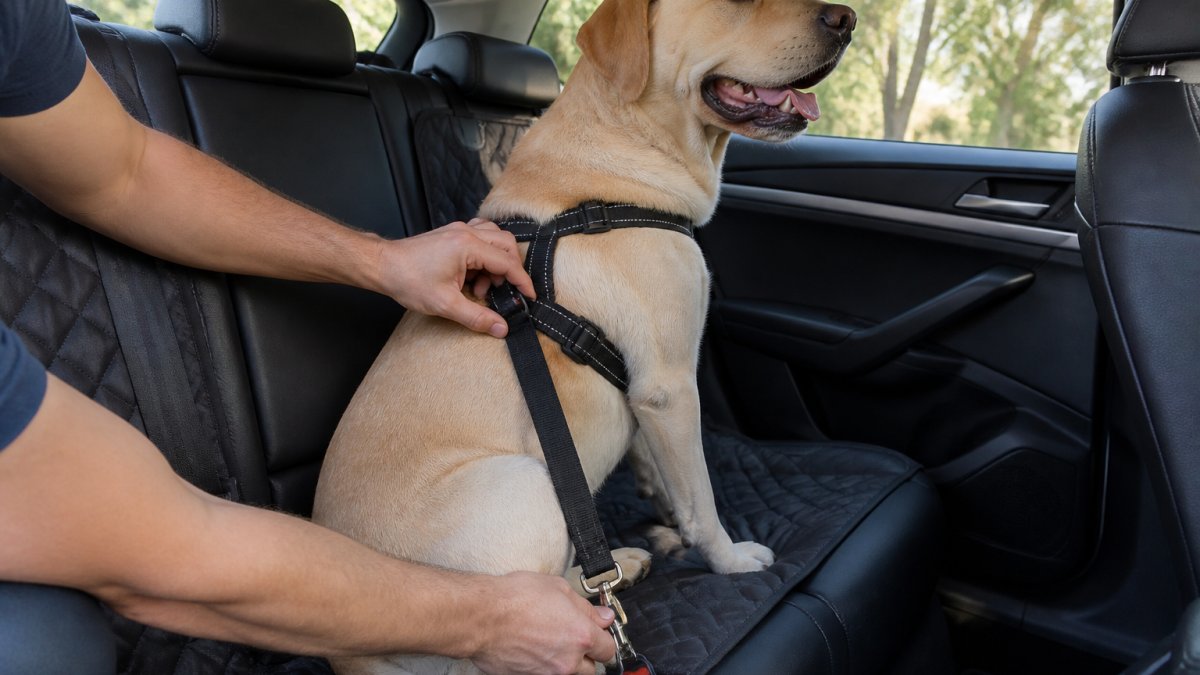
Here is the step-by-step version:
- Measure the chest girth at the widest point, just behind the front legs
- Weigh your dog and match that weight to the harness rating
- Put the harness on and tighten the chest strap until two fingers fit under it
- Check that the back D-ring or attachment sits between the shoulder blades
- Clip the tether to the back attachment, never to the collar
- Thread the tether through the vehicle seat belt or buckle it in
- Test the range: your dog should sit, stand, and lie down, but not reach the front seat
A common mistake is clipping the tether to the collar. In a sudden stop, that puts all the force on the dog's neck. Always attach to the harness back, not the throat.
Why Large Dogs Need Different Fit Rules
A harness that fits a Beagle will not fit a Great Dane, even if both are labeled "large." In a crash, the harness has to spread the dog's forward momentum across the ribcage and sternum without concentrating force on the neck, throat, or soft belly.
For a big dog, three fit problems show up again and again:
- Chest strap riding up onto the throat. This happens when the strap is too short for a deep-chested breed like a Greyhound, Doberman, or Boxer. The strap should cross the chest at the widest point of the ribcage, not the base of the neck.
- Back attachment drifting off the spine. On a broad-backed dog like a Rottweiler or Mastiff, a narrow harness can slide sideways. The D-ring should stay centered between the shoulder blades when the dog moves.
- Belly strap digging into the soft underside. A strap that sits on the belly instead of behind the ribs will slide forward under load and can compress the abdomen. It should sit behind the ribcage, not across the soft middle.
Fit Checks by Body Shape
Weight alone does not tell you which harness fits. Body shape does. Use these checks:
- Deep-chested, narrow dogs (Greyhound, Whippet, Doberman): look for harnesses with a longer chest strap and a Y-shaped front that avoids the throat. A standard strap harness will ride up.
- Broad-chested, stocky dogs (Bulldog, Boxer, Rottweiler): look for wide, padded chest plates and adjustable shoulder straps. Narrow harnesses will pinch under the front legs.
- Long-backed dogs (Dachshund, Corgi, smaller, but the principle applies): the back attachment should sit well behind the shoulders so the tether does not pull the spine sideways.
Sizing for Large and Giant Breeds
Sizing is where most large-dog setups fail. A harness rated for a 20 kg dog will not hold a 60 kg dog, no matter how well it fits.
Check the weight rating first, then the chest measurement. A giant breed often needs an XL or custom size.
- Small and medium: up to roughly 15 kg
- Large: roughly 15 to 40 kg
- Giant: 40 kg and above, often needing XXL or custom
If your dog falls between sizes, size up. A harness that is too tight rubs and restricts breathing. Too loose and the dog can back out of it.
Tether Placement and Vehicle Compatibility
Tether placement decides how well the whole system works. The tether should clip to the harness back and then to a fixed point: the vehicle seat belt, a buckle-in loop, or a seat-belt anchor. Not every car works the same way, some rear seat-belt buckles sit low and awkward, and some SUV cargo anchors are safer for a crate than a harness.
What a Crash-Tested Dog Harness Actually Proves
A crash-tested dog harness has been put through a simulated collision to see whether it holds the dog and limits force. But "crash-tested" is not one standard: different labs use different speeds, dummy dogs, and pass marks, so a harness can pass one test and fail another.
How a Real Sled Test Works
Most credible harness testing happens on a sled, not in a real car. The harness is fitted to a dog dummy on a seat buckled to a sled, accelerated to a set speed and stopped suddenly to mimic a frontal impact. Instruments record forces on the dummy's chest, neck, and spine, and high-speed cameras record whether the harness stretches, tears, or lets the dummy slip out.
The variables that matter most:
- Test speed. Many published tests run at around 30 mph (roughly 48 km/h). Some run lower. A harness that only passed at 20 mph tells you much less than one tested at highway-relevant speed.
- Dummy weight. A test dummy sized for a 30 lb dog does not represent a 90 lb Labrador, let alone a 150 lb Mastiff. Force scales with mass, so a large-dog harness needs a large-dog dummy.
- Pass criteria. A harness can "pass" if the dummy stays in the seat, or it can pass only if chest forces stay under a set threshold. Those are very different bars.
How to Read a Crash-Test Claim
When you see "crash-tested" on a box or product page, look for these specifics:
- Who ran the test, an independent lab, a university, or the seller's own facility?
- At what speed and with what dummy weight?
- Was the full report or a summary published, or is it just a logo?
A harness that passed an independent sled test at highway speed with a large-dog dummy tells you far more than a badge on a package.
What Crash Testing Does Not Cover
Even a well-tested harness has limits. A sled test is a single frontal impact at one speed with one dummy. It does not cover rollovers, side impacts, or rear-end collisions, how your dog's body shape interacts with the straps, or the tether, buckle, and vehicle anchor, only the harness itself.
Car Seat Pet Protection Travel Carrier →
Crash testing is necessary but not sufficient, the floor, not the ceiling. Fit, tether placement, and vehicle compatibility still decide whether the system works in your car with your dog.
The Safest Way to Restrain a Dog in a Car: Harness vs. Crate vs. Carrier
The safest way to restrain a dog in a car depends on the dog's size, the vehicle, and the trip.
Here is how the three options compare:
| Option | Best For | Main Strength | Main Limit |
|---|---|---|---|
| Crash-tested harness | Large and giant dogs | Keeps dog on the seat, easy to fit | Needs correct sizing and tether |
| Secured crate | Dogs that settle in a crate | Contains the dog fully | Must be tied down, takes space |
| Travel carrier | Small dogs and cats | Simple and portable | Not built for large-dog force |
For a big dog, a loose crate is no safer than no restraint at all. It can slide and tip in a crash.
A carrier works well for small pets but is not the right tool for a large dog. If you travel with a smaller pet, our Car Seat Pet Protection Travel Carrier gives them a dedicated, settled space on the seat.

For a large dog, a harness is our pick. It lets the dog sit or lie down and keeps the force on the chest.
Dog Seat Belt Laws by State: What Owners Should Check
Dog seat belt laws by state vary, and most places do not require a harness at all.
The law is a weak guide here. Even where no rule applies, an unrestrained large dog is still a danger to you and to the dog.
What to check for your state:
- Whether a loose animal in the cabin is restricted
- Whether dogs in truck beds must be secured
- Whether any law covers the driver's lap specifically
Laws change and differ by state and year. Check your state's current rules directly for official wording.
The practical takeaway: do not wait for a law to tell you to restrain your dog.
Helping a Large Dog Adjust to a Seat Belt Harness
Helping a large dog adjust to a seat belt harness takes patience, short trips, and treats.
Start at home. Put the harness on for a few minutes with no car involved. Give treats and take it off. Repeat over a few days until the dog ignores it.
Then move to the car:
- Sit in the parked car with the harness on, engine off
- Do a short drive around the block
- Build up to longer trips
If your dog panics, go back a step. A stressed dog who fights the tether can tangle it, which defeats the point.
Conclusion
Getting a large dog safely restrained is harder than it looks, and the wrong harness can give you false peace of mind. The fix is a crash-tested harness, sized to your dog's weight and chest, with the tether attached to the vehicle seat belt, never the neck.
At Munk'Goods, we carry car accessories built for real trips, from pet travel gear to interior upgrades. Our Car Kennel for Dogs, Cats & Small Pets gives smaller pets a secure travel space, and our Car Safety Belt Cover keeps the seat belt comfortable for human passengers on long drives.


Frequently Asked Questions
Is a pet seat belt safe for large dogs?
A pet seat belt can be safe for a large dog when the harness is sized to the dog's weight and chest measurement, the tether attaches to the back rather than the neck, and the product has been crash tested. A generic harness that only comes in small and medium sizes will not protect a large breed. Check the weight rating before buying.
How do you fit a seat belt harness on a large dog?
Measure the widest part of your dog's chest and match it to the harness size chart, then adjust the chest strap so two fingers fit flat underneath. The tether should attach to a D-ring on the dog's back, not the neck, and clip to the vehicle seat belt or a secured anchor point. Let your dog wear the harness indoors for short periods before the first drive so the fit can be checked while the dog is standing, sitting, and lying down.
Can a dog seat belt hurt a dog in a crash?
It can if the harness is the wrong size or the tether attaches to the neck. A loose harness lets the dog move too far forward before the restraint engages, and a neck attachment puts pressure on the throat during impact. A properly fitted, crash-tested harness distributes force across the chest and shoulders instead. Weight ratings matter here too, since a harness built for a 10 kg dog will not hold a 40 kg one.
Should a large dog ride in the front or back seat?
The rear seat is the safer choice for a large dog. A deployed front airbag can injure a dog sitting in the passenger seat, and a large dog in the front can distract the driver. If your vehicle has a cargo area, a secured crate or travel kennel is another option, but it must be anchored so it cannot slide. Position your dog in the back seat with the harness tethered to a seat belt in the rear.
Your dog's safety in the car comes down to the right gear and the right fit. Explore the Munk'Goods car accessories range to find travel and interior items that make every trip calmer, for you and your dog. Continue shopping and get set up before your next road trip.